China & Vietnam - May 2026
Click above to just view the trip through my photos collection.
As with my first visit to Japan last May, China has long been towards the top of my list of places I'd like to go. China being the world's longest continuous civilisation, with such a massive and deep history, China's influence on the world is foundational, it feels essential to have at least some experience there.
Despite that, and some familiarity with various aspects of Chinese history and culture, it is often characterised as enigmatic to us in the west... for good reason. Throughout my lifetime, there's been a general narrative around China here that isn't usually positive. Often it's based on fear, a new global power that supposedly threatens the comfort we have in Europe and North America, sometimes it's a clash of ideologies and the worry that there is another one out there that is having the success we claim isn't possible.
I'm not particularly interested in writing about those issues here, I mostly like to use my blog to highlight what I like. The internet, traditional media, etc, is centred on negativity and I don't find it enjoyable to add to that. Not that my minuscule personal blog has any impact on... anything. I don't say that to dismiss any real issues, I just don't think there is any value in me writing about them, nothing I could say on those issues would be new, original or persuasive.
I remember as a kid, the history I enjoyed reading about most were the Ancient Egyptians and Chinese. I came to the Greeks, Romans and broader European history later on - but Ancient Egypt and China were the first I remember really having an interest in at school.
But there were a few things that re-opened the idea of going to China in recent years:
- Accessibility.
- China is opening up to more foreign tourists, it is clearly attempting to push itself as a tourist destination and open itself up more to the wider world.
- Government policy, visa free schemes, etc - all contributed to reducing the friction in spending a reasonable amount of time in China.
- China's economic and civic development makes travelling as a foreigner a lot more comfortable. Chinese cities are often ultra modern, clean, functional and safe.
- An interest in modern China, not just the historical and cultural, but all the rapid development we've seen in recent decades. The cultural and technical exports becoming a larger part of our lives in the rest of the world. It's all hard to ignore and makes it even more interesting to visit.
- The mix of accessibility and it still feeling unique and novel. I fully expect travel to China from the west to skyrocket over the coming years, but it doesn't feel like everyone is going there yet.
The plan
As per the title, we also went to Vietnam, and I'll come to that later, but China was the primary focus of this trip.
High level itinerary:
- 10 days in mainland China
- Beijing, Xi'an, Shanghai
- 3 days in Hong Kong
- 7 days in Vietnam
- Hanoi & Ninh Bình
China
Visiting China this year for UK citizens is simple, we have visa-free travel until the end of the year (at least) for stays up to 30 days. All we had to do was fill in an arrival form. We went with Hainan airlines on the way there - 10 hour direct flight from Manchester, and originally had a return flight via Qatar, but cancelled that and went with Cathay Pacific HKG -> MAN due to the disruption in the region.
Hainan airlines was relatively impressive, it's a budget choice, but honestly it didn't feel miles behind Cathay Pacific or Qatar. Film & TV selection was a lot more limited, but still enough for me.
Beijing
Landing in Beijing, our first impression of the city was of the... interesting... urban planning. Something that came to characterise our time in this city, but I'll save that for a bit later. We got a Didi to our hotel just off Wangfujing Street, near St Joseph's Church.
For this post, I am going to just pick out some highlights across each city, I'm not doing a day-by-day retelling.
Temple of Heaven
After a nap, we had a walk around the local area, bought some power banks from a Huawei store, and then made our way towards Temple of Heaven. A 600 year old religious UNESCO world heritage site.
This wasn't particularly high on my list prior to coming to Beijing, but it was a pleasant surprise when we arrived. I think it comes across better and more interesting in person than on video/photos, the surrounding gardens are pleasant and the scale, detail and general spectacle of the building is impressive. As with any of the major attractions in Beijing, there are massive crowds, but it wasn't overwhelming - so many of the attractions here are built on such large sites - that they can quite easily handle these crowds.
As this was our first day, we didn't do much else other than some aimless wandering around the city, just getting used to some of the logistics (how do we pay for things with Alipay/WeChat, etc) of being in China.
Summer Palace
On the second day, our first stop was at the Summer Palace. Another UNESCO world heritage site, it's a massive site, with thousands of buildings, sprawling gardens and historical artefacts. We should be thankful that the various Chinese dynasties built their palaces on an enormous scale, because hundreds of years later, they're great at dealing with huge crowds of people.
There were a bunch of interesting buildings with beautiful ornamentation and well told history, but what I enjoyed most about this place was the gardens, trails and views. Again, around the entrance of the site, it was quite busy - but walk 10-15 minutes away and you can enjoy the calm, quiet trails - and some of the lesser visited attractions across the site.
This was one of the highlights of our Beijing stint, would definitely recommend this.
798 Art Zone
An ex-military factory, a collaboration between the Soviet Union and the PRC, the whole complex has been converted into a modern art district, full of art installations, museums, cafes and other interesting little shops. This was genuinely very good and another highlight of the Beijing stay, it doesn't always appear very high on the list of 'must see attractions' for international tourists, but I'd say it's worth it.
My only real complaint was that it felt like some of the paid exhibitions/galleries seemed quite expensive, not even just by Chinese standards. In general, things in China are really quite cheap, but entrance to one or two museums in particular here were about what you'd expect in Europe, and given the complex has many of them - if you wanted to see it all, you could spend a bit more than you expect to.
Either way, the buildings, the Soviet & Maoist iconography and the modern Chinese (and international) art was all a fairly unique part of our Beijing experience.
The Forbidden City
We did not enter through Tiananmen Square, the additional security logistics and queues around that didn't seem worth it, instead we approached the city from one of the side streets to skip straight to the entrance of the city/palace itself.
Like Temple of Heaven, the scale here is one of the most impressive aspects of this, but even more so. Thankfully, because whilst there were enormous amounts of people entering and moving around in the city, you still had plenty of space to explore.
I will say though, the scale of it does also mean I feel like we saw maybe.. 20% of it at most. I'm not sure how much of the nearly 1000 buildings are accessible, or notable, but this is an attraction worth experiencing. Photos don't do the scale or detail justice.
The Great Wall (Mutianyu)
You can't visit China without visiting the Great Wall. One of the Seven Wonders of the World, up there with the Pyramids of Giza, they're something you grow up hearing about, in formal education and popular culture.
Admittedly though, I wasn't necessarily expecting to care that much. I knew that sections of the wall, particularly those closest to Beijing had lots of modern reconstruction and facilities, which somewhat diminish the aura of an ancient wonder.
There are three sections often cited as the ones to visit from Beijing:
- Badaling: The closest and easiest to reach (~1 hour, direct train), but the most crowded and heavily restored.
- Mutianyu: A happy middle ground (~1.5–2 hours, best by car or coach). It's well restored with good facilities, great views and a toboggan, and has fewer crowds.
- Jinshanling: The furthest and least accessible (~2.5–3 hours), but the most rugged and original, with the best views and the fewest people.
As per the title, we went with Mutianyu. We hired a private driver for the day through Trip.com, which cost £80 - for effectively a 10 hour excursion. We were picked up and dropped off to/from our hotel and really cannot complain. It could have been significantly cheaper to go on a group tour/coach, but I think our experience was much better and well worth the £80.
On to the Great Wall itself, we took the chair lift up and the toboggan down. It's a bit of fun, definitely worth getting the chair lift up at least, there is also the more accessible (and a little less scary) cable cars. We arrived relatively early, so it felt like our first 1-2 hours on the section of the wall the chair lift dropped us off at was pretty quiet. It wasn't crowded, it felt like you could take your time and enjoy the impressive scenery.
Which is one of the reasons to visit this section of the wall, seeing the wall in full context, snaking over the mountains in the distance is really what drives home what a monument this is.
As we walked towards the section of the wall where the cable car (not chair lift) arrives, the crowds start thickening out... with lots of very annoying people. But that's.. whatever. Many people who chose that route do so maybe because they don't want to walk across the sometimes quite steep and awkward steps up/down the wall.
That is one of the most striking impressions of the wall, the steepness of it in some places, and this is something that is relatively recently restored - but I'm glad they kept some of that, adds a bit of authenticity back in.
One thing that slightly dampens some experiences in China is what I'm calling.. themepark-ification. Many historical sights, natural sights - get made ultra safe, accessible and built out with souvenir shops and restaurants. The core attraction itself is typically left mostly alone (aside from the millions of security cameras), but the surrounding development can take away from the experience. Not a lot, I'm not going to really complain about accessibility, it is of course more than worth it if people with less mobility can experience these attractions, but I think some of it could be done a little more tactfully.
All in all though, visiting the great wall is a childhood bucket list item checked off, and it was an enjoyable day out.
Random Hutongs
The image of China today, is often one of ultra modern cities, but Beijing still has many of its (apparently quickly disappearing, though) traditional neighbourhoods, characterised by its narrow alleyways and courtyard residences. On one of the days, in search of a good Jianbing, we found ourselves in a regular residential street, far away from any tourist attractions - and got a taste of what appeared to be something more authentic.
The Hutong we visited in the photo did feel like it had gone through a bit of gentrification and repurposing into a more retail focused district, but it still had some novelty that was worth the visit.
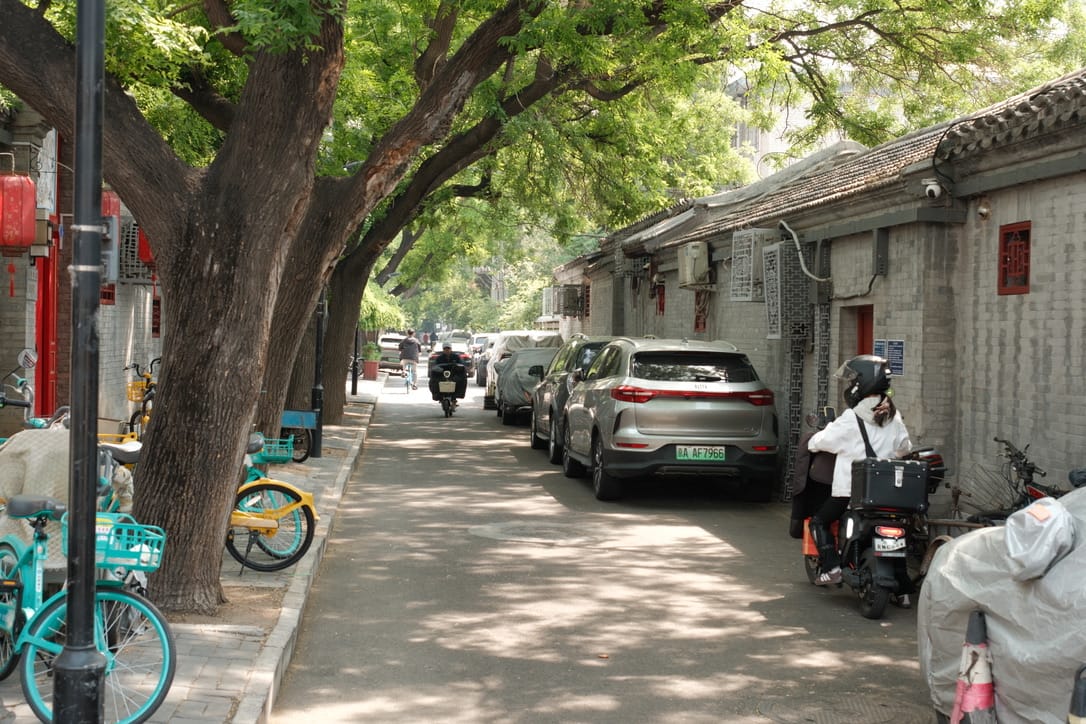
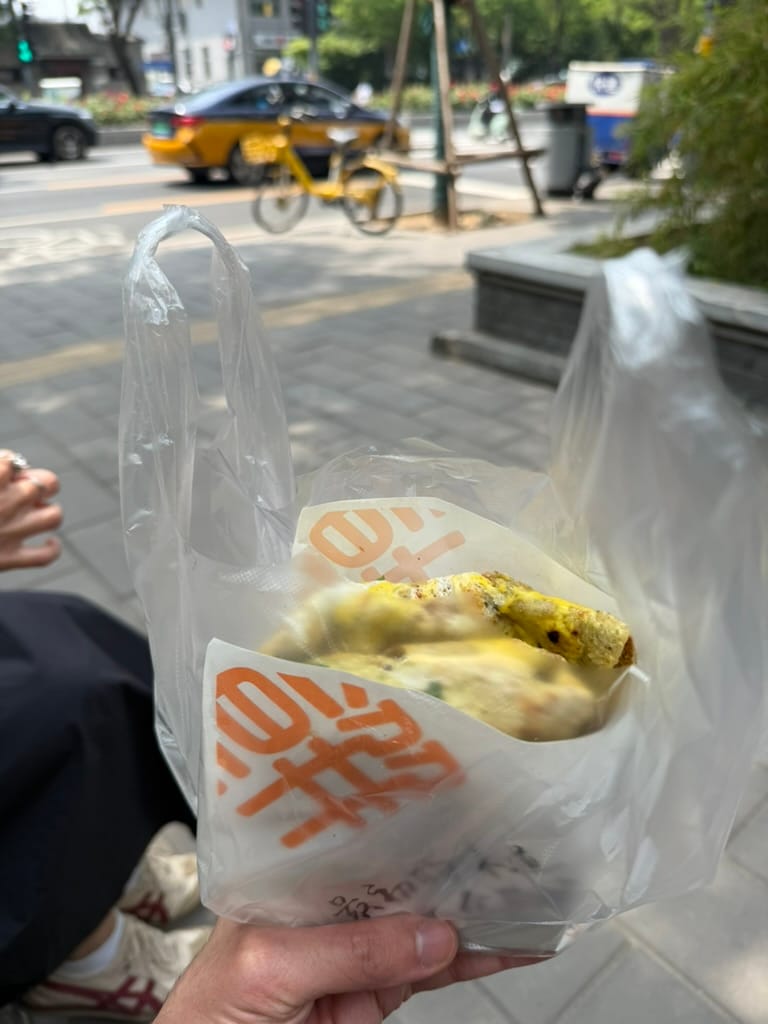
I would recommend having a walk around areas like these if you have time to spare. Tourism in Beijing is often so focused on the big, world-famous attractions, but these places whilst they are really just ordinary residential streets, do give Beijing a bit more.. flavour (especially if you find a Jianbing).
Beijing's.. interesting... urban design
In recent years I've become somewhat interested (very casually) in urban design and Beijing is a great example of what not to do. It might be the most annoying big city (in my experience) to get around. First of all, look at Beijing on a map.
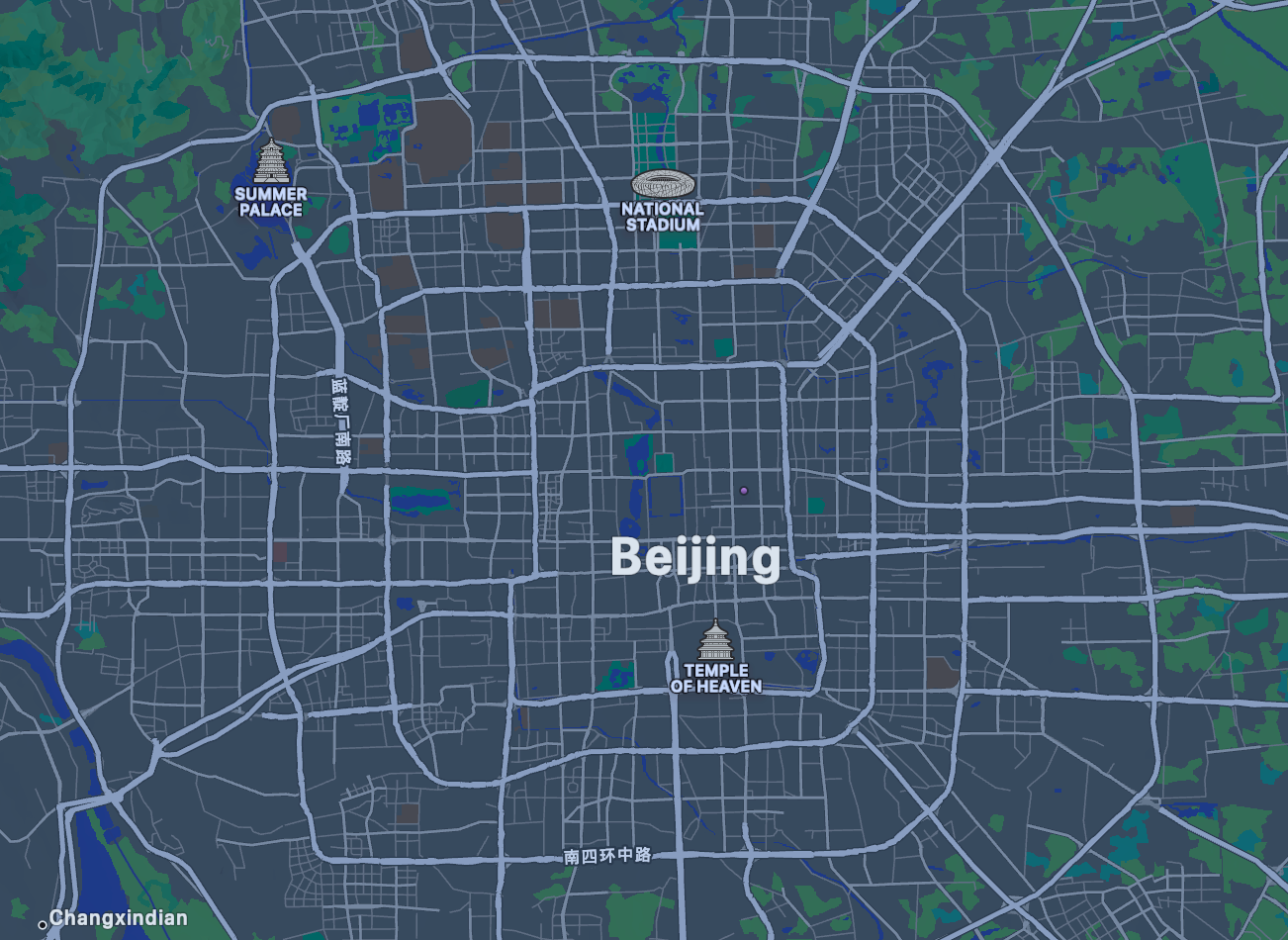
You'll notice the very grid-like design. Each block is enormous, and often single use. It seems like at some point in its development, post-WW2, Cold war era Beijing focused a lot on single-use zoning and gigantic roads everywhere. Beijing has an excellent metro system, but it can only do so much when the city above it is structured the way it is. So we ended up taking a lot of Didis around the city, which highlighted another problem - the extreme traffic.
What appeared to be a 2 mile drive would regularly have you sat in traffic for 20 minutes. Is it possible to navigate the city better than we did? Absolutely, but we chose the comfort of Didi premium - because the cars were very nice (all Chinese EVs), air conditioned, and extraordinarily cheap.
Beijing has so many great things about it, some of the most famous and significant landmarks on the planet, but it is let down by some odd planning decisions decades ago. It does feel like they're trying to make the best of it, like I said, there are many positive aspects - the amount of cycling, the metro system itself works really well (the mandatory security checks on a metro system feel.. very extra though) and it has many other conveniences of China.
This isn't a complaint or a disappointment, really, I somewhat expected Beijing to be like this and I otherwise enjoyed it.
Xi'an
Getting there
We took one of China's bullet trains from Beijing to Xi'an, the booking process was surprisingly a bit stressful. We booked through trip.com, our initial attempt to book first class seats failed, trip.com wasn't able to secure them when the tickets opened for the service we chose. I did find a marginally earlier train with first class seats shortly after though, so it turned out fine.
As with many things in China, if you're a foreigner, you book things with your passport and your tickets are.. registered against your passport. We arrived at Beijing train station, had to go through security (it's not as intense as Airport security, just put all your bags through a scanner), and then wait in a..very large waiting room for the train. You can't go down to the platform until the train has arrived.
There was a bit of confusion, as foreign passengers couldn't use the electronic gates, and unfortunately we ended up behind a very large foreign tour group going through a gate that had to be all checked in by.. a person. Either way, we got on, and were finally on one of China's much lauded 350 km/h high speed trains.
One thing we were excited to try was the 'order to your seat from real restaurants' along the route functionality, but the option wasn't available on stops that made it worthwhile, only on a stop about 30 minutes before our stop, so didn't get to try that.
Other than that, the train was great. Fast, smooth, on time, the 'first class' was comfortable. Nice big, adjustable seats. Service was great, the staff came around to all of us foreigners and let us know our stop was coming up soon and suggested we got ready with our baggage.
I'd have liked to have more experiences on China's high speed trains, but this was the only one of the trip. Getting from Xi'an to Shanghai seemed easier and faster by air, so we did that.
On to the city
Our immediate impressions of Xi'an were that it was definitely more compact, more walkable than Beijing, but still had some annoyingly large roads which forced you to walk quite a long way to find crossings (in some places, like around the Bell Tower, that was an underground pass). We checked into our hotel, which was really quite nice - spacious, really well equipped, modern, and absolutely dirt-cheap.
Muslim Quarter & the Great Mosque
For the first day, we had a walk around the Muslim quarter, tried a bit of street food, including a Roujiamo - which was a favourite. Visited the Great Mosque of Xi'an. Whilst the Muslim quarter and general markets all around are a popular tourist attraction, the deeper you went, the history and culture of the place did really begin to shine through.
At the entrance to the quarter close by the drum tower, there are a lot of flashy, highly commercialised stores, but keep going - turn down a few side streets and you get into what feels more like regular market and residential areas used by locals. These, and the mosque, were a highlight of our time in China.
Terracotta Army
The next day was focused around another one of China's world-famous attractions: Terracotta Army, otherwise known as Emperor Qinshihuang's Mausoleum. We got there early to try and avoid the notorious crowds, and, it was successful!
We got there, we could easily find places to stand along the barriers in the main pit without much fuss. This is another one of those discoveries/landmarks that you learn about as a kid, with many popular culture references to it throughout our life, so it does feel very cool to finally see it in person. I would really recommend doing some reading about the discoveries here and the wider history of the Mausoleum, it really does add a lot of necessary context and makes the discovery all the more impressive.
After exploring the various pits, we went to Lishan garden which contains the actual burial site for the emperor. It's a nice area, and the museum on the site is good, but I will say we didn't give ourselves enough time there. It's better to budget a couple of hours or so to take your time and appreciate the area. Similar to the main pits, I do think reading up on the significance of the site does really add a lot, I find the fact the actual tomb of the emperor remains sealed and mysterious very exciting.
They have not opened it, they fear opening it and damaging what's inside, as when the original terracotta army was discovered, the paint began flaking off it very soon after, due to exposure to the air. It's said they're waiting for better technology and techniques to preserve what's in there first.
There exists an account of what's in the tomb:
Palaces and scenic towers for a hundred officials were constructed, and the tomb was filled with rare artifacts and wonderful treasure. Craftsmen were ordered to make crossbows and arrows primed to shoot at anyone entering the tomb. Mercury was used to simulate the hundred rivers, the Yangtze, Yellow River, and the great sea, and set to flow mechanically. Above were representation of the heavenly constellations, below, the features of the land. Candles were made from fat of "man-fish", which is calculated to burn and not extinguish for a long time.
By Chinese historian Sima Qian
I'm sure there's mythology wrapped up in this stuff, but nonetheless, it's a very rare thing in the world today to have such sites remain a mystery.
City Walls at Sunset
Later that day after a walk around some of the modern shopping areas of Xi'an, we went for a sunset cycle around the city walls on a tandem bike. This was really enjoyable for me, not sure it was quite as enjoyable for Sonia, staring into my back - but it was a nice, relaxing way to look out over the city. The walls are large, not particularly busy and renting the bike was simple.
We finished the night at Yongxingfang food street, a modern street food market - we enjoyed what we had there.
Giant Wild Goose Pagoda & Tang Paradise
Our final day in Xi’an, it was particularly hot, so we focused on just a couple of attractions. The first being the Giant Wild Goose Pagoda, the pagoda itself gives a good view over the city and the surrounding gardens and shrines are pleasant. After this, we headed towards Tang Paradise, a ‘cultural’ theme park set to recreate the feeling of Tang royal gardens that once sat nearby.
We had a nice stroll around this park, it was quiet & relaxing with good scenery.
Shanghai
We flew to Shanghai from Xi'an, it's possible to get the train, but it is quite a sizeable distance and plane just made a bit more sense this time.
Shanghai immediately felt very different, in particular to Beijing. The urban planning in Shanghai is evidently leagues ahead, everything feels ultra clean and modern, but it has an interesting mix of European architecture and nice, leafy promenades. Shanghai felt more comfortable, more convenient and much more modern than Beijing and Xi'an.
Again, Beijing and Xi'an have some immensely impressive and culturally important attractions, and they're well worth visiting, but getting around and just 'existing' in Shanghai is better.
The Stage Observation Deck
Shanghai Skyline from 'The Stage' observation deck was one of the main events of our first night. Shanghai's skyline is undoubtedly one of the most impressive I've ever seen - feels curated (and I'm sure it is, to a degree).
For stretches of time, we had the observation deck almost to ourselves, at most there were around 10-15 other people and there's plenty of room to spread yourselves out. I suspect some of the more well known observation decks wouldn't be quite so enjoyable.
Former French Concession & Yuyuan Old Street
The following day, emphasising the theme of just wanting to stroll around the city.
We went around shopping areas, the former French Concession and 'Yuyuan old street'. The latter is basically a bit of a theme park, but enjoyable enough.
Shanghai Greenhouse Garden
Our final day, the main attraction, other than a fair amount of shopping - was Shanghai Greenhouse Garden, in Shanghai Expo Park. It's supposedly the largest greenhouse in Asia and it felt like it. I really did enjoy this, great variety, not in the slightest bit crowded - it was relaxing and quite interesting.
Shopping
We spent the rest of our final day in Shanghai shopping, Sonia bought a couple of Muva bags which were significantly cheaper than they are in the UK. It's a Chinese brand, which is perhaps why - we found international brands were broadly the same price as at home (or marginally cheaper), but you can save quite a bit on China's own brands.
I bought an Insta360 X5, which with the bundle I bought, was almost half price what Insta360 were selling it on Amazon UK for. The staff in the Insta360 store were super helpful, the device works just as it would if I had bought it in the UK.
We didn't prioritise attractions in Shanghai, we got enough of that in Beijing and Xi'an. We wanted to relax a little bit and as mentioned, Shanghai is a pretty good city for that. I absolutely want to spend more time here in the future and maybe see a few more traditional touristy attractions and maybe some not-so traditional. I regret not going to the Shanghai Urban Design museum.
Hong Kong
Our first trip to Hong Kong in October 2025 was good, but it was also rushed, very hot and humid and we landed feeling very tired and a bit sick. Hong Kong is unique, so we wanted to see more - so we incorporated 3 nights in HK as part of this trip.
Kowloon & Temple Street
After landing in HK airport, we took a taxi to our hotel in Kowloon. On our first trip, we stayed on the comparatively more modern and cosmopolitan Hong Kong Island. Which was great, but for something a bit different - Kowloon is considered the more 'authentic' and 'local' experience. I do sometimes object to people distinguishing 'modern' away from 'authentic', especially when millions of people's day to day authentic lives are in that 'modern' reality. Age and tradition don't have a monopoly on authenticity.
Anyway, after a nap - we went wandering around Temple Street Night Market and down to the harbour.
With my previous rant aside, you do get more of the stereotypical 'Hong Kong' aesthetics in Kowloon which is a cool experience.
Cha Chaan Teng & M+
The next day, we planned a museum visit. Before that, we had breakfast in a traditional Cha Chaan Teng (a Hong Kong style cafe). This was yet another stereotype-breaking experience with Hong Kongers, because yet again, the staff were super nice - really welcoming, and helped us out with the menu and some recommendations.
On both visits, I have yet to really experience the supposed rudeness or unkindness of Hong Kongers - in fact, the complete opposite. It remains the only foreign country I've visited where multiple strangers on different occasions unprompted - stopped and offered help when we were looking a bit lost or confused.
In the West Kowloon Cultural District, we went to the M+ museum of contemporary art. There was a special exhibition on Korean artist Lee Bul. We somehow spent a good 4.5 hours here and it really didn't feel like that. It's an excellent museum and would be interested in revisiting it for any new exhibitions in the future.
It has a good location on the harbour too, so a good place to get a view of the city. It was a drizzly day, but it was a welcome change from the heat in Beijing/Xi'an/Shanghai.
Hung Hom Kwun Yum Temple & Nian Li Garden
Our final drizzly day, we focused on some temples and gardens. Specifically Hung Hom Kwun Yum Temple and Nian Li Garden.
A staff member at Hung Hom Kwun Yum spoke to us about the religious traditions and walked Sonia through one which was cool, again, super nice and welcoming.
Nian Li Garden was pleasant too, and it's free, but we ran into a rather large tour group that somewhat dampened the experience in some areas. Overall, worth a visit though. These traditional gardens and temples are so interesting in the Hong Kong backdrop.
Mong Kok at Night
Later that night, I went back out for a walk around Mong Kok to take some photos.
I really like Hong Kong. Hong Kong International is a good hub for the region, there's plenty still left in Hong Kong I'd like to see and plenty nearby (e.g. Macau, Shenzhen and some of the nature of Hong Kong).
Vietnam
We took Hong Kong Express (airline) from Hong Kong to Hanoi, a short flight, but it's an airline that gives Ryanair a run for its money in terms of... budget airline nonsense. It did the job though, so can't complain too much.
Hanoi
We landed in Hanoi early in the morning quite tired and immediately feeling the intense humidity. We had a brief walk around Hoàn Kiếm Lake (~5 mins from our hotel), came back to the hotel, ate and then napped until the early evening.
We knew we were coming at a potentially risky time of the year, either: rainy, or very hot and humid, or both. The first evening was.. very rainy.
The first proper day in Hanoi, we explored the 'old quarter', had a Banh Mi and Vietnamese coffees. Hanoi is an experience. It's loud, hot, humid, chaotic - and no one can accuse it of being boring. I'll have to say, enjoyable isn't necessarily the word that comes to mind immediately at this point - but it is what I expected of Hanoi.
The city is also known as one of, if not the most polluted city in the world (at least at certain times of the year). After a day of walking around the old quarter, my skin was getting visibly dirty, black with soot. That is something I've never experienced before. I could wipe my hand down my arm and see the soot come off.
This isn't a complaint, we knew Hanoi is like this, we went anyway because it is an experience and does have many interesting things about it. The Vietnamese people were immediately nice, kind and polite - service was almost universally great so far.
Tam Cốc
The next day, we headed to Ninh Bình, specifically Tam Coc to stay in a frankly ridiculous private villa. Too big for just us two, but it was reasonably priced, in an amazing location. The idea was that we might want a relaxing break away from Hanoi, so we got this - with its own (small) private pool and great views.
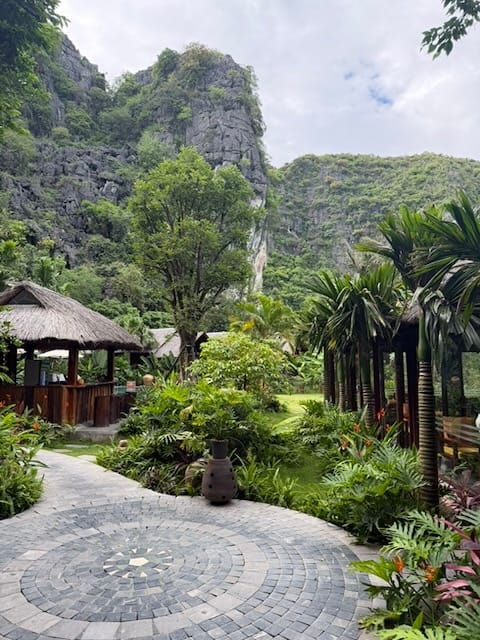
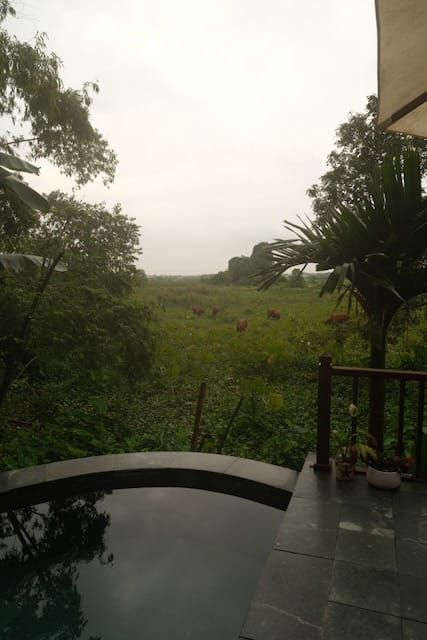
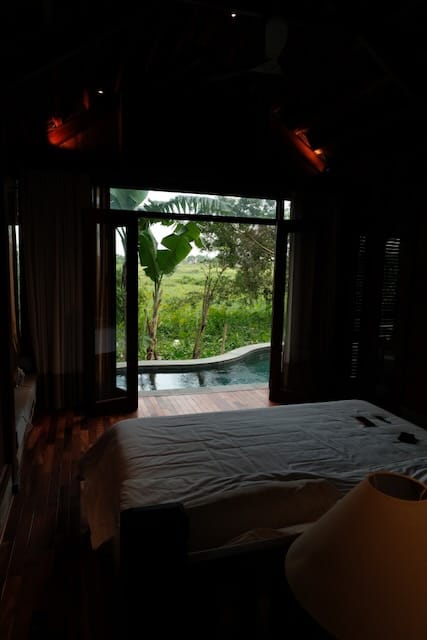
Random pics from our accommodation
We took one of the 'luxury limousine' buses which was good value and comfortable.
We jumped on the bikes provided by our accommodation to explore the local area.


Click through the post above to see some of the first proper tests of my Insta360 clamped to the bike. This was already a nice break from Hanoi and is much of what I imagine when I think of.. Vietnam.
In hindsight, I regret not spending more time biking around the local area, it was so nice with some pretty amazing scenery.
Hang Múa
Later that evening, we thought we'd hike up Hang Múa for sunset. A few things:
- There unfortunately wasn't much of a sunset
- Both of us made the mistake of wearing sandals. I never wear sandals, but my trainers got absolutely soaked on the first night and thought given we're here in rainy season, it probably makes sense. It was a tricky, but doable hike up.
- The humidity was intense. Walking up seeing people walking down with t-shirts looking like they'd been entirely immersed under water wasn't encouraging.
The view was worth it though and despite it being quite busy with a few impatient morons trying to force us to push past young children who were a bit slower and were struggling up and down some particularly precarious parts of the path, it was well worth it.
Tràng An
Tràng An was the main attraction for our last day, a huge UNESCO world heritage site, focused on rowing boat tours around the area and through many caves. We were on the boat with another couple.
I can't quite remember which route we did, but you can choose one of three (I think?), and I was more than happy with what we experienced. There were numerous stops to get off the boat and walk around temples and take in the views, and it felt well paced and relaxed.
For much of the rest of the day, we had a brief look around Tam Coc, but returned to relax in our villa. We knew we were returning to Hanoi, so just wanted something chilled, especially as we were coming towards the end of a three week trip where we were pretty full on for most of it.
Our biggest regret of Vietnam was probably basing ourselves in Hanoi for the week. I feel like 3 days in Hanoi would have been enough for us, we should have spent 4 days minimum in Ninh Bình / Tam Coc.
But back to Hanoi we go..
Hanoi, again
Train Street
We hadn't planned on seeing a train go through Train Street. It had always seemed like a bit of a silly attraction and we didn't really want to participate.
But after dinner one evening, we were coincidentally walking towards the most famous stretch of track and a cafe owner flagged us down from a street or two away - telling us a train was coming and she had seats free. So.. we went along with it. The drinks were cheap and we didn't have anything else planned.
I got my 360 camera out and waited.
I do stand by it being a bit of a silly attraction in many ways, but it is a novel experience and I'll admit it was pretty cool. Would I prioritise it over other things? Probably not - but if you have time and are in the area, go for it.
The last few days
Otherwise, we didn't do much of note in our final days in Hanoi. We went to Hỏa Lò Prison, which was a great museum and I'd recommend it - but like most museums, it's better experienced than read about. Other than that, it was intensely hot and humid (39°C at one point), so we spent a lot of time in air conditioned shopping centres and did things like visit aquariums. We were happy with that, at the tail end of a three week trip it's fine to just unwind.
Vietnam overall
Overall, I enjoyed Vietnam. We should have allocated more time away from Hanoi, but what we experienced was largely good.
Great food.. although I'm ashamed to admit we didn't find a single good Banh Mi. Mere hours after landing back in Manchester, we went to our favourite Manchester lunch spot, Viet Deli. Banh Mi aside though, the baseline quality of what we ate was high. And as someone who doesn't habitually drink coffee, I loved the coffee here.
The people were super nice and welcoming, and what we experienced of Vietnam was very foreign tourist friendly - which is a bit of a contrast with mainland China. Not in a bad way, but I'll get to that.
Wrapping up
China was the highlight. It's fascinating and enjoyable, and we left knowing we'd be back for more.
On the not-so-tourist-friendly thing - I'm just talking about the fact that day to day life in China, outside of the very popular tourist places, doesn't really expect non-Chinese people. So language and app barriers can be a bit tricky. It's all doable, and sounds like it's a million times easier than it used to be.. and if anything, that extra bit of challenge adds a bit of texture to a trip like this. It's all part of the experience.
And Hong Kong - I've already said I really like it, but it's genuinely become one of my favourite cities. It's so unique, with its own style and aesthetic, and despite it being so dense, so urban, it feels surprisingly comfortable.
So we'll be back - to China to see new places (and probably a bit more of Shanghai), and to Hong Kong.. I can't imagine I'd ever say no to the opportunity to stay a few more days there.
Member discussion